Our aim is to make our training programs accessible and affordable for all. We have therefore chosen to adapt all our training fees according to the purchasing power of different regions (currencies). For information about the training fee in your currency, please enter your country of residence and your country’s currency in the fields below
CFFTP5 Learning to Question
For professionals working within Education, Youth work, Social work, Children’s services!
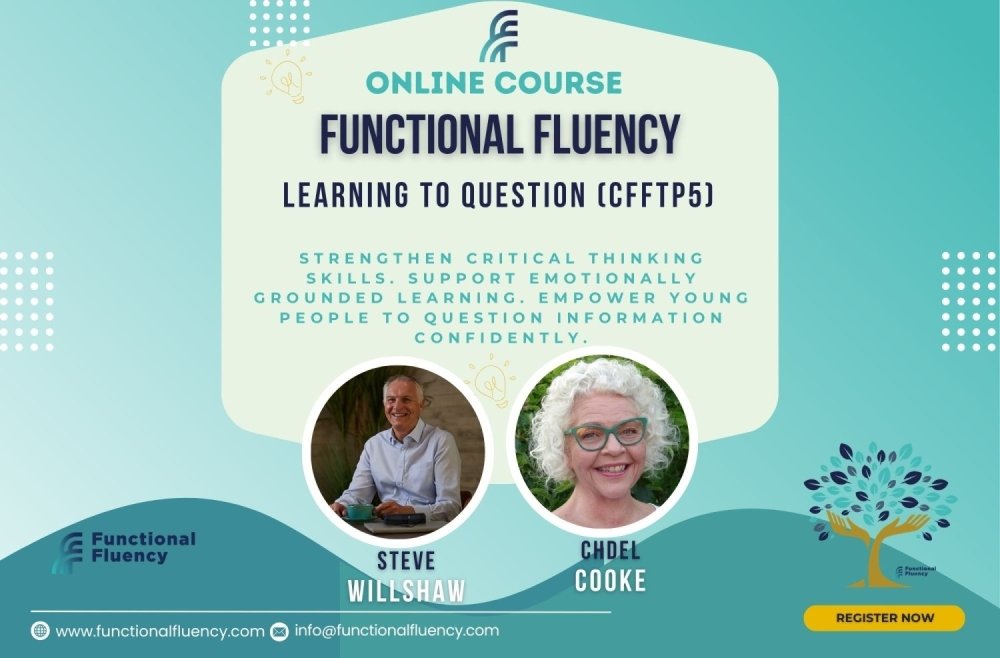
The CFFTP5 Learning to Question workshop, one of the five core elements of theCertified Functional Fluency Teacher Programme, introduces educators to a Functional Fluency-informed approach to critical literacy, emotional awareness, and reflective inquiry. Developed by Steve Willshaw and Chdel Cooke, this practical and psychologically informed course equips professionals with tools to help young people critically evaluate information while remaining emotionally grounded.
Using a structured six-step “Accounting Framework,” participants learn how to guide students through the process of assessing both their internal emotional reactions and the external reality of the information they encounter. The framework can be applied across media literacy, classroom discussion, subject-specific learning, and wider pastoral practice. The workshop combines practical teaching strategies with deeper psychological understanding to support both intellectual development and emotional regulation.
What Makes This Workshop Unique?
Emotional Grounding Before Critical Thinking.
Many critical thinking programmes focus solely on evidence analysis and rational debate. Learning to Question takes a different approach by recognising that learners often cannot engage critically until they first feel emotionally regulated and psychologically safe.
Before evaluating information, participants are taught how to:
Notice emotional reactions
“Get grounded”
Use Functional Fluency “Aware” behaviours
Move from reactive states into reflective inquiry
This creates a more sustainable and compassionate pathway into critical literacy.
A Practical “Accounting Framework”
At the centre of the workshop is a six-step Functional Fluency-informed Accounting Framework that helps educators and students assess both:
Inner current reality (emotions, reactions, assumptions)
Outer current reality (facts, evidence, context)
Participants explore how the framework can be applied to:
Media headlines
Online misinformation
Social narratives
Classroom discussions
Subject-specific content
Pedagogical decision-making
Cross-Curricular and Workload Conscious
The workshop is designed with real classroom pressures in mind. Rather than introducing another disconnected initiative, the framework provides educators with a “radically simple” structure that can be embedded across subjects and settings without creating additional workload.
The Expertise Behind the Programme
Steve Willshaw With more than 30 years of experience as an English teacher, Head of Department, educational consultant, and Functional Fluency professional, Steve brings deep expertise in literacy, critical analysis, and practical curriculum design.
His work focuses on translating complex psychological concepts into accessible classroom strategies that educators can realistically implement within existing systems.
Chdel Cooke As a counsellor, UKCP trainee in advanced clinical psychotherapy practice, Transactional Analysis practitioner, certified TIFF Provider, and Get on the Mat Facilitator, Chdel brings a strong therapeutic and neuro-affirming perspective to the course.
Her work ensures that the emotional grounding elements of the framework are psychologically safe, inclusive, and accessible for diverse neurotypes and learning profiles.
The Synergy
Together, Steve and Chdel combine pedagogical clarity with therapeutic insight, creating a workshop that supports both critical thinking and emotional resilience. The result is a practical framework that addresses not only how young people think, but also how they feel while processing increasingly complex and emotionally charged information.
How Functional Fluency Is Integrated
The workshop directly applies Functional Fluency concepts by transforming the principle of “Accounting” into a practical educational framework.
Participants explore how Functional Fluency behaviours such as
Awareness
Regulation
Rational thinking
Relationship-building
can help learners move from emotional reactivity toward reflective, evidence-informed thinking.
This enables educators to support young people in navigating misinformation, online influence, peer dynamics, and social anxiety with greater confidence and emotional safety.
This workshop is particularly valuable for
Teachers of all levels and subject areas
School leaders
Heads
Youth workers
Social workers
Pastoral and wellbeing staff
Common Challenges This Workshop Addresses
Professionals working with young people are increasingly facing:
Student anxiety and emotional dysregulation
Digital misinformation and manipulative online narratives
Educator burnout and initiative fatigue
Student disengagement and apathy
Lack of coherent whole-school approaches to emotional literacy and critical thinking
Difficulty helping students critically evaluate emotionally charged information
Participants will leave with:
A Functional Fluency-informed Accounting Framework
Strategies for emotional grounding and reflective inquiry
Practical tools for teaching critical literacy
Techniques for dismantling misleading media narratives
Neuro-affirming approaches to classroom discussion
Cross-curricular strategies that minimise additional workload
Greater confidence in supporting emotionally safe critical thinking
Workshop Format
Delivery Format: Online workshop via Zoom Duration: 2 hours Group Size: Minimum 10 / Maximum 20 participants Date:11 September 2026 Time: 09:00 - 11:00 UTC