Our aim is to make our training programs accessible and affordable for all. We have therefore chosen to adapt all our training fees according to the purchasing power of different regions (currencies). For information about the training fee in your currency, please enter your country of residence and your country’s currency in the fields below
What leaders might learn from Tango
(and what it’s teaching me about how I lead)
Yesterday, during my tango lesson (and yes, I take tango lessons) something landed in me.
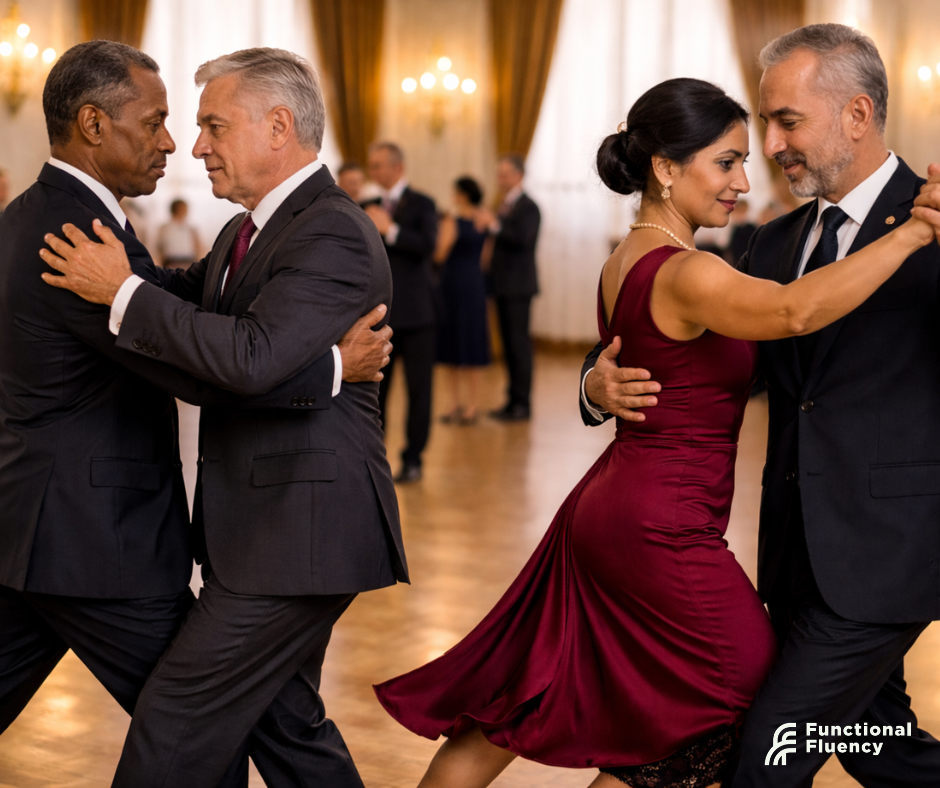
I’m learning to follow in tango, which, as it turns out, is not about passively being led.
My teacher gently reminded me:
“It’s not about guessing or anticipating. Stay connected, feel the invitation, then respond in your own way.”
And just like that, I wasn’t thinking about the dance floor anymore. I was thinking about leadership, and also about myself, because if I’m honest, this is exactly where I get challenged.
The Tango teaches something leadership often forgets
Tango is a conversation, it is not scripted. It unfolds moment by moment through connection, and the role of the follower (my role) is deeply active. It requires trust, intuition, and interpretation.
You’re not being “led around.” You are listening with your body, shaping the dance as much as your partner. The leader doesn’t drag or push, they offer direction. They create space… and then they wait.
That “waiting” part is where I notice myself, because I don’t always wait.
Where I recognise myself
More than once, I caught myself anticipating, moving too soon, trying to get it right instead of staying with what was actually happening. It’s subtle, but it changes everything, and it made me reflect on how often I might do the same when I’m leading.
Stepping in too quickly, filling the space, moving ahead of what’s really there. Not out of bad intent, just habit, or pressure, or from wanting things to move.
The problem with power without attunement
We live in a time of disruption and polarisation and a lot of noise that looks like leadership, but doesn’t feel like it. It often shows up as pushing, directing, being certain, but standing on that dance floor, it struck me how little that works when there is no real connection.
If the lead becomes rigid, unclear, or forceful, the dance doesn’t flow. You feel it immediately because it becomes mechanical, slightly off, like something is missing, even if the steps are technically “right.”
A different kind of power
Tango doesn’t reward force, it asks for something else.
The ability to notice what’s actually happening
The patience to not move too quickly
The sensitivity to adjust
The awareness that what you do affects the other
None of that is abstract. I can feel, in my own body, when I lose it.
The intelligence of moving with
Tango is teaching me that following is not passive, it's alive, present and responsive, and it makes me think differently about leadership - being in relationship with what’s unfolding. With people, with context and with the moment.
Good leadership, like good dancing, has something of that quality. You sense, you wait, you respond, and when it works, it’s no longer about who is leading and who is following. It just works.
A thought that stayed with me
On the way home, I found myself wondering why this is so hard. Not the steps, but the staying connected, the waiting, the responding to what’s actually there.
Because when I look at leadership around me, I don’t just see direction or decision-making. I see how quickly people move away from what really matters. It often turns into holding position: being certain, pushing forward.
And without awareness, without connection, without the ability to respond to what’s actually unfolding . . . it becomes disruptive. You can see it everywhere.
Final note
Tango keeps teaching me something I can’t ignore.
That how I show up, moment by moment, either supports connection… or disrupts it.
And that leading well is less about having all the answers… …and more about staying aware enough to adjust.