Our aim is to make our training programs accessible and affordable for all. We have therefore chosen to adapt all our training fees according to the purchasing power of different regions (currencies). For information about the training fee in your currency, please enter your country of residence and your country’s currency in the fields below
What Ants Can Teach Us About Functional Fluency
By Leona Bishop.
How a Spanish holiday, a curious 5-year-old, and a trail of breadcrumbs inspired a reflection on behaviour.
The other day, I was sitting outside in Spain with my daughter and my three grandchildren. The sun was warm, the olives were salty, and the children, as children do, were happily making a mess.
My five-year-old grandson had just dropped a bit of toast when he suddenly crouched down, completely absorbed.
“Look!” he said. “The ants are carrying it away!”
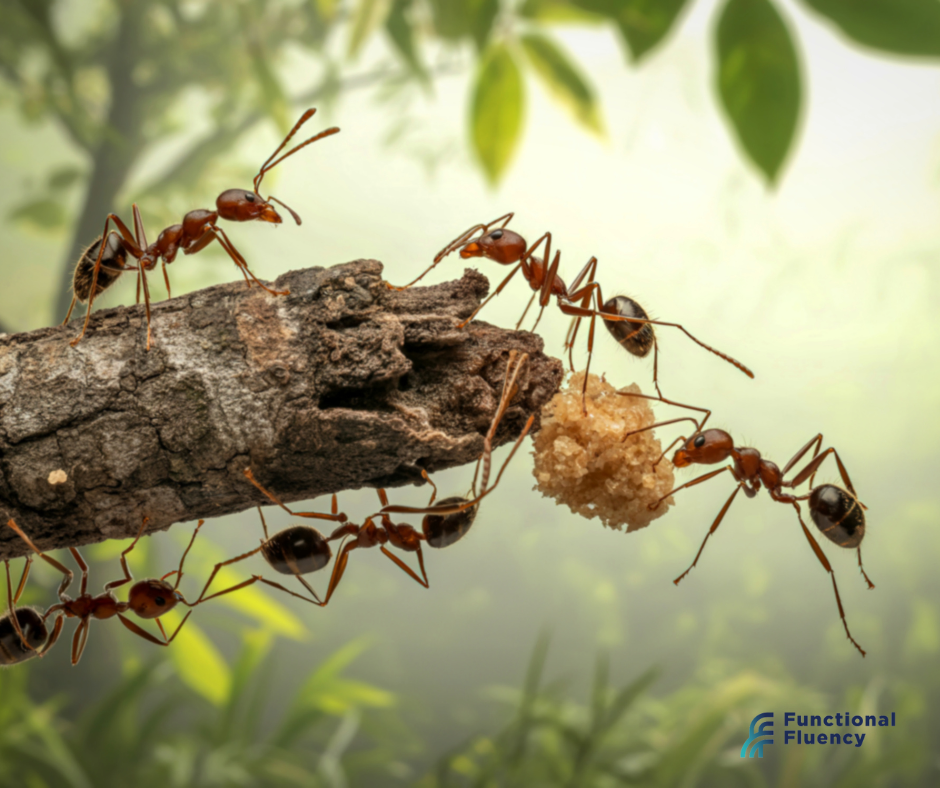
And indeed they were. Tiny little workers, hauling crumbs bigger than their own heads. Within minutes, they’d formed a perfect procession, each ant taking a turn, no chaos in sight.
Then, of course, the experiment began: He deliberately dropped a few more bits. Not to make mischief - but because he wanted to watch. “Wow,” he said. “They really help each other.”
And just like that, my coaching brain kicked in.
There we were, surrounded by evidence of something that many of us humans struggle with every day: Working together, staying responsive, moving with purpose. Getting things done, without drama.
Ants, it turns out, are highly Functionally Fluent.
And that moment - with crumbs on the ground and questions in the air - inspired me to write this blog.
What is Functional Fluency?
In short: it’s the skill of choosing effective behaviour for the situation you’re in.
The Functional Fluency framework helps us become aware of our habitual responses, shift from unconscious reaction to intentional action, and build more harmonious, productive relationships - with others, and ourselves.
The model includes five 'Golden Modes' - behaviour patterns that generate energy and positive results - and four 'Purple Pitfalls' - patterns that drain energy and undermine effectiveness.
Ants don’t argue with what’s happening, they don’t freeze when the path is blocked. Instead, they stay alert, pick up new signals, and change course.
I watched them pause, assess the situation when my grandson accidentally stomped near their trail (oops), and calmly reroute - as if they were saying: "Right, what’s actually going on here?".
It’s behaviour that’s aware, grounded, rational. Not reactive, but responsive.
There’s no panic, no blame, just an enquiring presence focused on what’s constructive.
Accounting Mode in action is like asking: “What matters most right now, and what’s the wisest next step?”
2. Structuring Mode: Organising with clarity and consistency
If ants had job titles, they’d be very clear. No one is confused about their role in the colony. They’re not flapping around wondering who’s supposed to do what. Instead, there’s a calm, well-organised rhythm to their work: one line in, one line out. No micro-managers, just firm, helpful structure.
It reminded me of an inspiring team lead who creates clear frameworks without being rigid and keeps everyone moving. Not by barking orders, but by being authoritative, consistent, and, yes, even a bit inspiring.
Structuring says: “Let’s put systems in place that support everyone, not stifle them.”
3. Nurturing Mode: Caring for the collective
This one often gets overlooked in the ant world, but it’s there. Ants cherish their young. They tend to their eggs, they carry injured colony members home. It’s not dramatic, just deeply compassionate, quietly empathic behaviour.
They are not doing it to win points, it’s in service of the whole. That’s Nurturing Mode: seeing value in every member, and encouraging growth and resilience.
It’s the kind of mode that says to a colleague, “You’ve got this - and I’ve got you.”
Nurturing asks: “How can I be understanding, without losing boundaries or clarity?”
4. Cooperative Mode: Teamwork without ego
Watching those ants collaborate is like watching the best kind of team: No fuss, no fight for credit, no drama, just flow. One ant moves aside, another steps in. They adjust, flex, and carry on.
They’re friendly, assertive, and resilient. They don’t collapse if one thing doesn’t work - they adapt and move on. There’s mutual respect in motion.
It reminded me of a project team where each person considers the others, brings confidence to their role, and flexes when needed.
Cooperative Mode whispers: “We’re stronger together, so let’s get this done side by side.”
5. Spontaneous Mode: Creative responsiveness
This might be my favourite. When the ant line suddenly broke, maybe a gust of wind or a curious toddler’s hand, they didn’t give up. Instead, they played with new paths. One tried a wild curve, another explored a shortcut. There was a curious, expressive, even zestful energy to the way they kept experimenting.
It’s not chaos, it’s imaginative, responsive flow, and a reminder that sometimes, the best solution comes when we allow ourselves to be creative, even a little playful.
Spontaneous Mode says: “Let’s try it this way, just for now.”
But what happens when we humans lose the plot?
Ants seem to have it figured out - no drama, no derailing, just functional flow.
But humans?
We’re a different story.
Sometimes we slip into patterns that look like we’re contributing, but actually drain energy and disrupt the team.
Maybe you've met these characters…
There’s the one who always needs to be right. They talk over others, shoot down ideas, find fault in every solution ... and if something goes wrong? They are quick to point fingers, but never at themselves.
The mood tightens, people stop speaking up and initiative shrinks.
Then there’s the overly nice one.
They want everyone to get along, so they say yes to everything, even when it's too much. They protect, cover up, bend the rules “just this once”… and quietly burn out.
Eventually, others stop trusting what they really mean, or where they stand.
Or the one who says yes on the outside… but no on the inside.
They nod, smile, and go along , but deep down, they’re anxious, resentful, or quietly plotting their resistance.
Nothing moves forward, frustration builds and no-one knows what’s real.
And of course, the wild card.
Late, loud, can’t be counted on. They have great energy, until they disappear mid-task or derail a meeting with a random joke or emotional outburst.
It’s exhausting... and it pulls attention away from what matters.
We all slip into these patterns sometimes, especially when stressed, overloaded, or unheard.
But unlike ants, we can choose to pause, reflect, and shift, and that’s where Functional Fluency becomes our superpower.
Because when we become more aware of how we’re behaving, and what that behaviour is costing us, we can return to the Golden Modes and choose actions that serve the team, the task, and ourselves.
What’s YOUR 'ant style' in a Team?
You don’t need to shrink down and join an ant colony (although wouldn’t that be fascinating for a day?!), but you can start observing how you behave when you're part of a group - especially under pressure.
Are you the one who stays grounded and helps the team evaluate the facts?
Do you naturally bring order and clarity to the chaos?
Are you the one who quietly supports the emotional needs of others?
Do you jump in to collaborate, adapt, and move things forward together?
Or are you the one sparking creative ideas when things feel stuck?
And just as important:
What happens when stress hits or roles blur?
Do you become bossy or overly nice? Withdraw or overcompensate?
Do you notice when your energy shifts - and how that impacts the people around you?
Being part of a team means your behaviour is never just about you.
The way you show up shapes how others respond, which in turn shapes the team’s culture and results.
Would you like to go deeper?
We've created a few playful ways to help you explore your own patterns and sharpen your Functional Fluency:
1. Download the Worksheet: “Think Like an Ant” (see file below).
A guided reflection tool to explore your Golden Modes and where you might need a little ant-style wisdom.
My grandson keeps asking if we can go out again and “feed the ants.” He’s fascinated by their teamwork, their focus and their ability to get things done without fuss.
Maybe he sees something in them that we sometimes forget in ourselves:
We are all part of something bigger. And when we use our energy wisely, we can carry more than we think.