Our aim is to make our training programs accessible and affordable for all. We have therefore chosen to adapt all our training fees according to the purchasing power of different regions (currencies). For information about the training fee in your currency, please enter your country of residence and your country’s currency in the fields below
When Human Behaviour Scales
A personal reflection on conflict, awareness, and the human impact of behaviour at scale in an increasingly reactive and fast moving world.
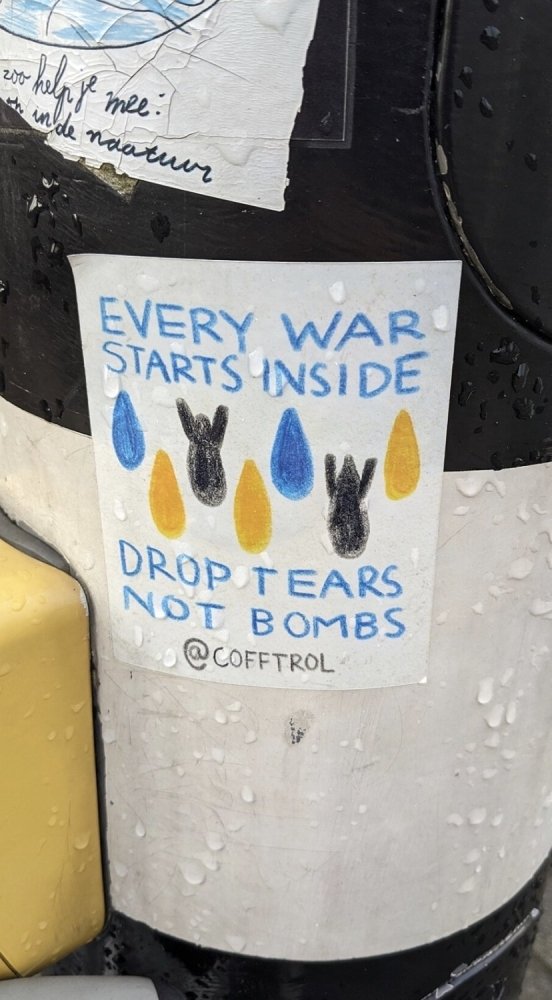
Yesterday, I was cycling through Rotterdam on my way to the hairdresser when I stopped at a traffic light and noticed a sticker attached to the pole.
“Every war starts inside. Shed tears, not bombs.”
I stayed there longer than necessary while cyclists passed and the traffic light changed a couple of times. I had already been trying to write about geopolitics, human behaviour, and Functional Fluency for a while, and this sticker brought it all back into focus.
Strange how a small sentence in the middle of an ordinary day can suddenly cut through the noise. The words stayed with me because they pointed toward something deeply recognisable.
I often notice how easily conflict gets spoken about as though it exists somewhere outside ordinary human experience, something geopolitical, historical, ideological, or far away from daily life. Yet every large scale conflict is still made up of human beings responding to fear, uncertainty, humiliation, pain, power, loss, identity, and survival.
Before conflict plays out collectively, politically, or globally, it often begins much closer to home, inside human beings themselves, in the inner worlds we carry and in the ways we respond to fear, pain, uncertainty, power, and disconnection.
Conflict itself is not new. Human beings have always struggled with difference, territory, power, belief, and belonging. History is full of tension and violence. Yet lately, I keep sensing that something has shifted. The pressure feels closer somehow, faster and more relentless, with far less space to breathe, reflect, or recover between one emotional impact and the next.
We are living in a world where human behaviour is constantly exposed, amplified, rewarded, attacked, analysed, and repeated in real time, and I often wonder what that is doing to us psychologically, relationally, and collectively.
Through social media, emotional reactions spread within seconds. Through AI, information multiplies faster than most nervous systems can meaningfully process. Adults and children alike absorb outrage, fear, certainty, performance, comparison, and conflict at a pace previous generations never had to navigate.
Pressure stacks, and under pressure human awareness narrows.
People can become more reactive, more rigid, more certain. Curiosity weakens. Nuance disappears. The ability to stay present in discomfort becomes harder to access. I notice these patterns in individuals, teams, organisations, political systems, and sometimes in myself too. The scale changes, but the underlying dynamics often feel surprisingly familiar.
A reactive conversation can damage trust between two people. A reactive organisational culture can slowly erode safety, creativity, and connection. A reactive political decision can shape the lives of millions and affect generations yet to come.
Same species. Same nervous systems. Same behavioural mechanisms.
Across cultures, personalities, generations, and belief systems, one thing remains true: human beings behave. The question I keep returning to is how effectively we behave and what our behaviour creates, both for ourselves and for the wider systems we are part of.
Does our behaviour move us toward greater awareness, responsibility, and possibility? Does it strengthen life around us or slowly exhaust it? Does it help future generations inherit a world with enough humanity left in it to sustain meaningful connection, care, and coexistence?
These questions seem relevant everywhere: in families, schools, leadership, communities, organisations, online spaces, and international systems alike, because every system is ultimately made up of human beings carrying inner worlds that influence how they respond to outer reality.
Fear that is not acknowledged does not disappear. Pain that is not processed does not disappear. Humiliation, grief, loneliness, rage, and disconnection do not vanish simply because we become adults.
They continue to shape behaviour. And behaviour shapes families, cultures, organisations, societies, and eventually history itself.
Perhaps that is partly why this moment feels so intense to me. I sometimes wonder whether it is becoming harder to avoid the consequences of unconscious behaviour at scale. I see it online every day, and if I am honest, I notice how easily I can get pulled into it too. I am no saint watching humanity from a safe distance. I am another human being inside the same system, trying to notice what strengthens connection and what weakens it.
That matters, because behaviour spreads. Calm spreads. Contempt spreads. Fear spreads. Hope spreads. Love spreads. Rigidity spreads. Reflection spreads too.
And despite all the noise, I still notice countless moments where people choose differently. Parents repairing after reacting. Leaders pausing before escalating. Young people asking thoughtful and uncomfortable questions. Communities quietly supporting one another without broadcasting it for approval.
These moments rarely dominate headlines or algorithms, yet they may matter more than we realise, because what we strengthen grows more available under pressure.
None of this requires a perfect world. Human beings will always disagree. Conflict, tension, and complexity are part of life. Technology will continue reshaping how we think, relate, and respond.
Human beings are perhaps unique in the extent to which we can reflect on ourselves, become conscious of our behaviour, and intentionally shape the systems we participate in. That capacity carries enormous responsibility, because the way we think, behave, organise, consume, create, and respond does not only affect our own survival, but increasingly influences the future of the planet and the many forms of life that depend on it.
Perhaps that is what this moment is asking of us. Not perfection, purity, or constant agreement, but greater maturity, greater awareness, and greater responsibility for the impact of how we behave with ourselves, with one another, and with the world we are shaping together.