Our aim is to make our training programs accessible and affordable for all. We have therefore chosen to adapt all our training fees according to the purchasing power of different regions (currencies). For information about the training fee in your currency, please enter your country of residence and your country’s currency in the fields below
From Jumbled to Joyful: The Rubik’s Cube of Team Life, Inside and Out
Understanding Team Dynamics: A Functional Fluency Perspective
We paused for a moment, letting that sink in, and then someone else jumped in:
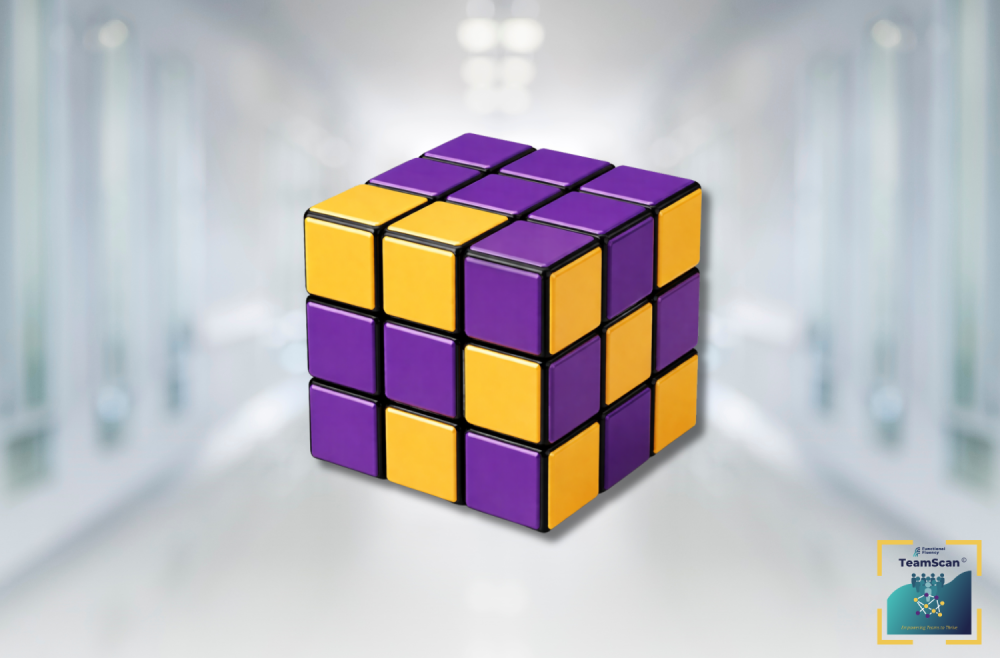
“It’s like a Rubik’s Cube!”
I could see exactly what they meant. Teams can often feel like colourful puzzles, full of potential, yet at times completely jumbled.
When you pick up a freshly scrambled cube, the colours are scattered everywhere. You know there’s an underlying order, but it’s hidden beneath the chaos. Teams can be like that too.
Much like the well-known Iceberg metaphor, only part of a team’s life is visible on the surface. Behaviour is what you notice above the waterline, while many deeper forces lie underneath shaping what happens. The Rubik’s Cube takes this idea further, because every twist on one side shifts pieces on all the others.
Teams are complex systems, and understanding team dynamics is a core challenge in organisational development, learning and development, and HR practice.
The six colours of a team cube
In a standard Rubik’s Cube there are six colours. In a team, you could imagine each colour representing one of six dimensions that shape how it functions:
1. Behaviour and interaction – What you see on the surface: the patterns of communication, collaboration, decision-making and conflict. In Functional Fluency this links to how the Golden Modes or Purple Pitfalls show up in daily life.
2. Roles and structure – The visible framework that holds the team together: agreements, responsibilities, boundaries, processes and goals.
3. Connections and dynamics – The way people relate: trust, influence, communication styles, informal alliances and how people position themselves in the group.
4. Motives and undercurrents – The often unseen forces: drivers, assumptions, personal histories, the stories people tell themselves about “how things are done”, and the emotional climate.
5. Wider system – The context the team belongs to: its history, its relationship to other teams and departments, the organisation’s culture, and the external environment shaping what is possible.
6. Timing and circumstances – Where the team is right now: its stage of development, current challenges and opportunities, and the momentum or pressure of the moment.
From scrambled to aligned
When a team takes a good look at itself, the cube can appear scrambled, the “colours” (these six dimensions) are scattered across every face. People may not even realise there is an underlying order, they justfeelthe complexity.
Without awareness, it’s easy to keep making moves that mix things up even more.
The moves that matter -behaviour as a leverage point for team development
If the structural basics — roles, responsibilities, agreements — aren’t clear, things can quickly become messy. That’s often the best place to start. From there, you can explore other dimensions:
Looking at how relationships and dynamics are flowing.
Bringing awareness to hidden undercurrents that may be shaping the team’s “personality”.
Considering how the larger system and the timing of events are shaping today’s reality.
As with solving a cube, one good move in the right place can create space for the other pieces to shift too.
A structured process, not guesswork
Just as you don’t solve a Rubik’s Cube by random twisting, you don’t align a team by guesswork. In puzzle-solving, you use an algorithm - a repeatable sequence of moves that gradually brings order. In team development, the “algorithm” is a guided process:
1. Assess reality – See the cube as it is now (the TeamScan). 2. Create awareness – Understand which moves (behaviours) help or hinder across all six colours and notice what is being discounted. 3. Choose effective actions – Identify which colour (dimension) to start with as a catalyst, then consistently work through the others. 4. Integrate new patterns – Practise using the Golden Modes intentionally across all six dimensions, in ways that benefit both people and purpose. 5. Sustain the shift – Keep practising until alignment becomes second nature.
Beyond solving today’s scramble
In many teams and organisations, the six dimensions can end up holding each other hostage.
An unclear structure can fuel relational tensions, unspoken histories and inner pictures can block trust and collaboration and external pressures can amplify stress in behaviours.
The dimensions themselves aren’t stuck - but when the pieces within them are misaligned, they disrupt the flow and feed dysfunctional patterns across the team and organisation.
You can imagine that addressing this isn’t a quick fix.
Functional Fluency works by steadily disrupting these patterns in individuals (including leaders), teams, and organisations. By doing so, it frees up energy and makes space for a Functionally Fluent culture, one where the dimensions reinforce each other instead of getting trapped.
The joy of a solved cube - when teams are aligned
A completed Rubik’s Cube is deeply satisfying. Everything is in its place, yet still flexible enough to move when needed.
A Functionally Fluent team can feel like that too. The colours (dimensions) are aligned, energy flows well, and challenges are met without unnecessary friction.
Of course, a team is never truly “finished”. because the system keeps shifting, the context keeps changing, and people keep growing or moving on, but when you know how to play the game, the twists and turns become part of the fun.
Reflection for team leaders and practitioners:
Which “colour” / dimension of your team is closest to alignment right now?
Where are the colours / dimensions most mixed?
How is the bigger system influencing your cube?
What’s one behavioural shift that could start moving your team closer to alignment this week?
And if it’s not a quick fix - how could you keep practising until the change becomes part of how your team works?
The session is designed for coaches, OD, HR, and L&D professionals who work with teams and want a practical, behaviourally grounded way to understand what’s really going on - and where a small, intentional shift could make the biggest difference.